Your child's third birthday is coming, and with it the question of what comes next, which is why so many parents start by reading about options for families finishing Early Intervention. Knowing how to prepare your child for ABA therapy makes that next step feel less like a cliff and more like a path. Most of the preparation happens at home, in small steps, before the first session. Here is what helps children with autism and children with Down syndrome settle in, and what helps parents feel ready too.
Why Getting Ready Early Makes a Difference
In Massachusetts, Early Intervention serves children from birth to age 3, and when it ends, ABA therapy is available at First Steps Developmental Services for children under age 6. Many families who come to First Steps Developmental Services started in the state program and found us as that chapter was ending.
A few weeks of preparation at home can make the first sessions calmer for your child and less stressful for you. If you have read about early support for toddlers with autism, you already know how much these early years matter.
How to Prepare Your Child for ABA Therapy in 7 Steps
Gather Reports From Current Providers
Collect recent evaluations, progress notes and goal summaries from anyone who works with your child, including speech, occupational or physical therapists. A Board Certified Behavior Analyst (BCBA) reviews your child's current skills before writing a plan, and these documents help the team see the whole picture sooner. Keep copies in one folder you can bring or share.
Write Down What You See at Home
No one knows your child's day better than you. For about a week, jot down short notes: when transitions go smoothly, what tends to end in tears, how your child asks for things, and which routines are hardest. These notes are practical, not clinical. They give the BCBA real examples to start from.
List Your Child's Favorite Things
Favorite snacks, songs, toys, shows and textures matter more than most parents expect. In play-based ABA, the things your child already loves become the motivation for learning new skills. A list of ten favorites, plus a few strong dislikes, is one of the most useful things you can bring on the first day.
Check Insurance Before the First Session
For children with Down syndrome, a Massachusetts law, Chapter 388 of the Acts of 2024, took effect on January 1, 2026. It requires most commercial insurers, MassHealth plans and the state employee plan to cover ABA, speech, occupational and physical therapy for a Down syndrome diagnosis. If your child has an autism diagnosis, ask the team to check your plan's ABA benefits. Individual plans still decide authorization, so benefits are verified at intake. Calling ahead means you know what to expect before therapy starts.
Practice Short Separations and New Places
If your child has rarely been apart from you, practice in small doses: a short visit with a grandparent, a story time at the library, a few minutes in an unfamiliar playroom. Each short goodbye that ends in a happy reunion shows your child that you come back. Keep goodbyes brief and calm, because drawn-out goodbyes are often harder on young children than quick ones.
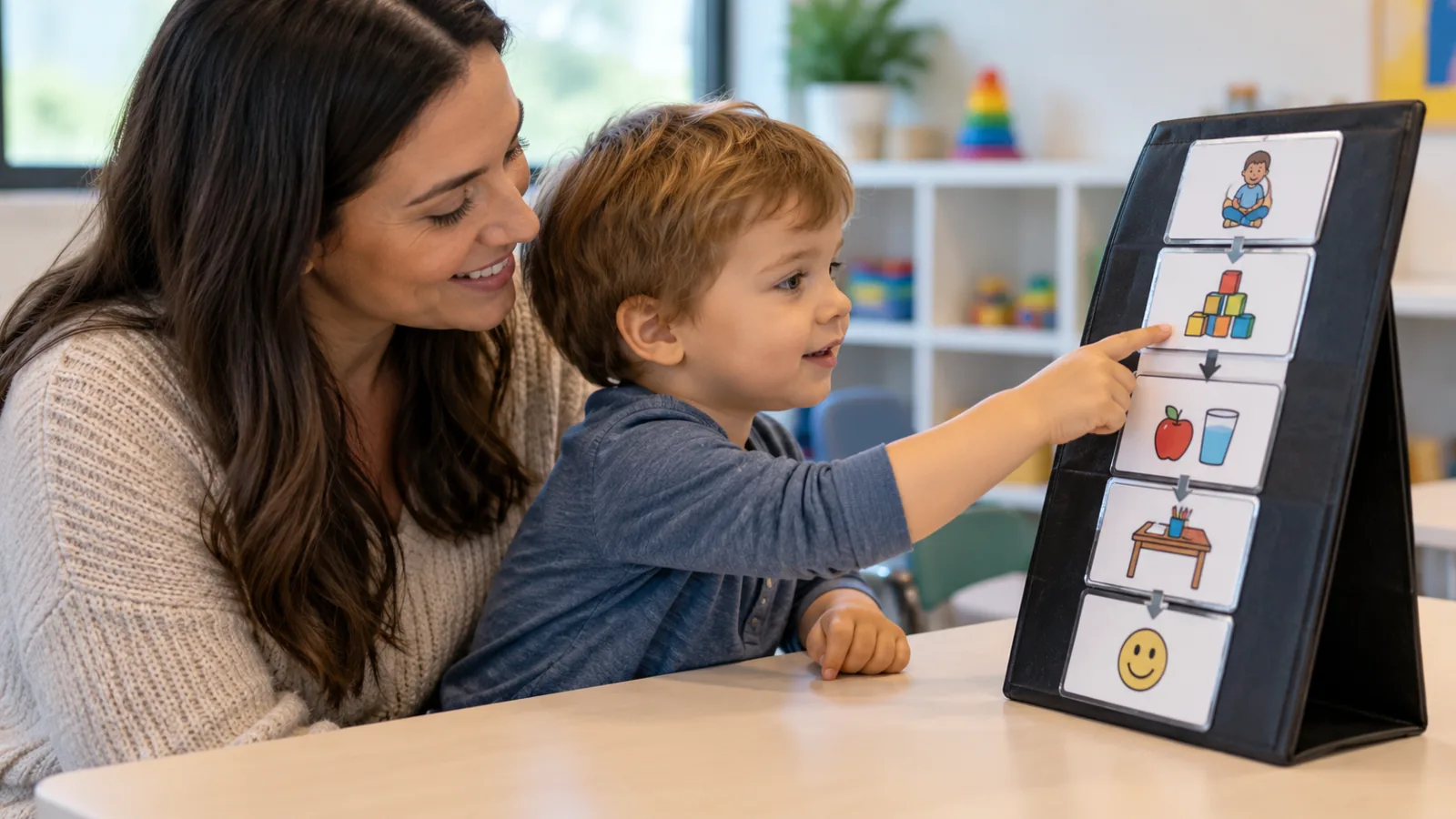
Preview the New Routine With Pictures
Many young children handle change better when they can see it coming. Show photos of the car ride, the building and the playroom, or draw a simple picture schedule together. A first-then board is an easy way to begin: first we go to the center, then we have a snack in the car.
Plan for Your Own Role, Too
Progress is easier to keep when what happens in sessions carries over to home. At First Steps Developmental Services, the BCBA goes through the treatment plan with the family before sessions begin, explaining each goal and how progress will be tracked. Ask how parent coaching works and how you will hear about your child's day.
What the First Weeks at the Center Look Like
The first sessions are about getting to know your child. A BCBA reviews your child's skills, communication and developmental priorities, then builds an individualized treatment plan with specific, measurable goals. Your child works with a dedicated 1:1 therapist, so there is time to build trust through play.
The center in Woburn offers half-day programs of 4 hours and full-day programs of 8 hours, in two play spaces called the Discovery Room and the Explorers Room. Ask which program length fits your child's stamina and your family's week.
Autism and Down Syndrome: What to Adjust
These steps work for children with autism and for children with Down syndrome, but the starting point is often different. Down syndrome is a condition a child is born with, so many families arrive with records from the very first months and a clear picture of their child's needs. Families of children with autism may be newer to the diagnosis and still learning what their child responds to.
For a plain-language overview of autism and the kinds of support available, the Centers for Disease Control and Prevention (CDC) keeps an autism resource page for families. Whatever your child's diagnosis, bring what you have. The plan is built around your child, not around a label.
Getting to the Center From Nearby Towns
First Steps Developmental Services is at 18 Commerce Way in Woburn, close to the I-93 and I-95 interchange. Approximate drive times are about 7 minutes from Stoneham, 12 from Wilmington, 13 from Burlington, 17 from Winchester, 19 from Lexington and 20 from Arlington. Times vary with traffic, so a practice drive at the same time of day as your child's program is a simple way to see what the commute will feel like.
Questions Parents Ask Before Starting ABA
What Should We Bring on the First Day?
Bring the folder of reports, your notes from home and the list of your child's favorite things. A familiar comfort item, like a small toy or blanket, can help too. Ask the team ahead of time what else to pack, such as snacks or a change of clothes, so the morning feels simple.
What If My Child Cries at Drop-Off?
Many children need time to warm up to new people and places, and tears in the first days are common. The therapist's first job is building a relationship through play. Share what comforts your child at home so the team can use it from the start, and ask how they will keep you updated.
Can We Get Support in Another Language?
Yes. Language support is available in English, Spanish, Portuguese, Korean and Japanese. Mention your preferred language when you first call so it can be arranged.
Taking the Next Step With Confidence
Learning how to prepare your child for ABA therapy is mostly about small, familiar steps: a folder of reports, a list of favorite things, a few practice goodbyes and a picture of what the new day will look like. None of it has to be perfect. What matters is that your child arrives feeling a little more ready, and you arrive with the information the team needs.
Turning 3 can feel like the end of something familiar. It can also be the start of support built around exactly where your child is today, whether your child has autism, Down syndrome or both. When you're ready to talk through your child's next step, contact us to get started.
About the Author: Jarrod Scalzo
Jarrod Scalzo, MSEd, BCBA, LABA, is the Founder and CEO of First Steps Developmental Services, an ABA therapy center dedicated to supporting young children with autism, Down syndrome, and developmental delays, along with the families who care for them. With over 20 years of experience in special education and Applied Behavior Analysis, Jarrod earned his Master's degree in Severe Special Needs Education from Simmons University in 2009 and became a Board Certified Behavior Analyst in 2014. He founded First Steps Developmental Services with a mission grounded in his own experience as a parent: to give every family the tools, knowledge, and compassionate support they need to help their child build a strong foundation for lifelong success. His approach centers on evidence-based care, caregiver partnership, and creating environments where children feel safe enough to grow.