What Early Support Looks Like at Home
Your child is two. They are not saying much, or not pointing, or not responding to their name the way you expected. Someone has suggested an evaluation and now you are wondering whether ABA at home this young is reasonable or premature. The short answer is that the first three years are when the brain is most responsive, which is exactly why services exist for this age.
Why the First Three Years Matter
Very young children are not miniature versions of older children. They learn through repetition inside ordinary moments, hundreds of them a day, in the places where they already feel safe. A two-year-old is not going to sit at a table and complete a lesson. They are going to hand you a cup, or not hand you a cup, and that moment is the lesson.
For children with Down syndrome, children with autism, and children with other intellectual disabilities, those ordinary moments often need to be set up deliberately rather than left to chance. The Centers for Disease Control and Prevention (CDC) notes that starting support early gives children the best chance to build communication and social skills, and for toddlers, that support works best where the routines already are.
Waiting until a child is older does not make the work easier. It usually makes it longer.
What a Session at Home Actually Involves
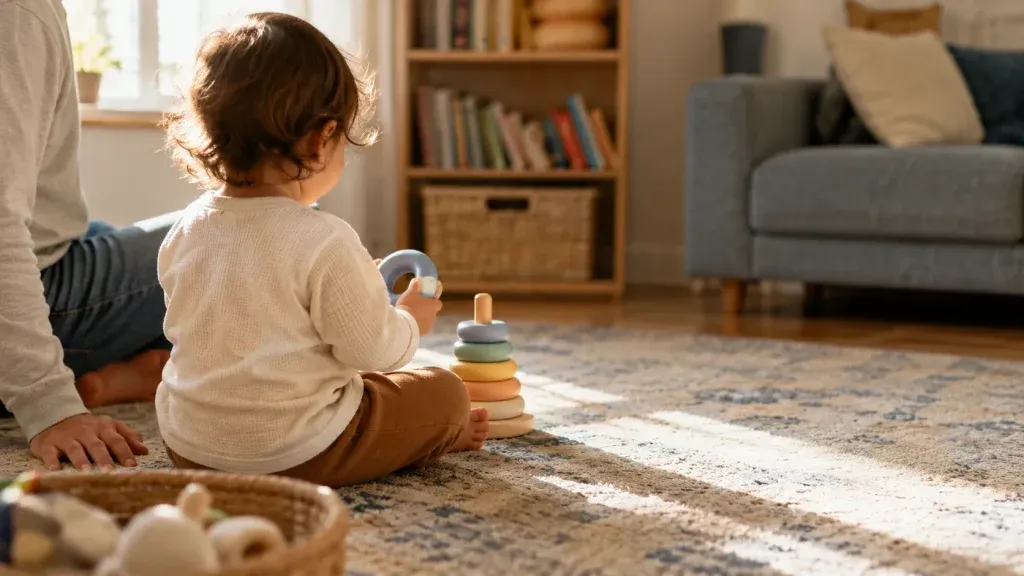
Most parents picture something clinical and are relieved when it is not. A home session looks like an adult on the floor, playing, following the child’s lead, and building a target skill into whatever the child is already doing.
Skills Built Into Daily Routines
The work happens inside real routines rather than around them. Getting dressed, mealtimes, the walk to the door, the moment a toy runs out. Functional communication, play and joint attention, self-help routines, sleep, and mealtimes are worked on in the situations where they actually happen, not rehearsed separately and hoped for later. Sessions are one-to-one, and programs are designed and overseen by Board Certified Behavior Analysts (BCBAs) with experience in early childhood development.
Caregivers Stay in the Room
This is not a service where you hand over your child and step out. Caregiver collaboration is part of every session, which means you are learning strategies as they happen, with your own child, in your own home. That is what makes something stick between visits rather than fading by Thursday.
When Home Is the Right Place to Start
ABA therapy for toddlers does not have to begin at a center. Families often reach out about home-based services when they recognize a few things at once:
-The child is under age 3
-New places and transitions are genuinely hard
-The worst moments of the day happen at home, around meals, sleep, or routines
-Getting to a center every day does not fit the family’s schedule
-Communication, play, or social skills are slower to emerge than expected
None of that means a center is off the table later. Starting at home is an entry point, not a permanent category, and many families move toward center-based or hybrid programs as the child grows.
The Part Most Families Do Not Expect
Peer interaction is one of the hardest things to practice in a house with no other children in it. That is why weekly play groups are included with the home-based program from the start, held at the Woburn center rather than in the home.
It gives a very young child a gentle, supported first experience of a room that is not theirs, with children they do not know, while the person they trust is right there. By the time a family considers a center-based program, the setting is already familiar.
Home-based clinicians travel to families within about ten miles of the Woburn center, which covers Winchester, Burlington, Wilmington, Lexington, Arlington, Stoneham, and Andover, along with newer additions such as Reading, Medford, Melrose, and Somerville, across Middlesex, Essex, and Suffolk counties.
Coaching also happens in the language a family actually uses at home. The team supports families in English, Spanish, and Portuguese, which matters when a parent is being taught a strategy in real time rather than reading it later.
Questions Families Ask Us Most
Is my child too young to benefit?
Under three is not too early. It is the window where children with Down syndrome and children with autism tend to make the fastest gains in communication and play, because those systems are still forming. If anything, the more common regret we hear is the opposite one.
Do we need a diagnosis first?
Yes, for insurance-funded ABA services. If you are still gathering information and do not have a diagnosis or evaluation, a developmental screening is usually the more useful first step, and it does not commit you to anything.
Is home-based ABA covered by insurance?
Massachusetts law requires insurers to cover ABA therapy for children with an autism diagnosis. Since January 2026, coverage is also required for children with a sole Down syndrome diagnosis, and the law does not limit that to a particular setting, so home-based services are included. Individual plans still determine authorization, so benefits are verified during intake before services begin.
Starting Where Your Child Feels Safest
There is no version of this where a parent feels fully ready. What usually helps is realizing that the first step is smaller than it sounds: a conversation, then an assessment, then a person on your living room floor playing with your child.
Children with autism and children with Down syndrome do not need to be old enough for a classroom to start building communication and connection. Our approach is modern and ethical, led by what the child is already interested in, and built around your family rather than a fixed curriculum.
If your child is three or under and you are wondering what support could look like at home, contact us and we can talk it through.
Meet the Expert Behind Our ABA Therapy at Home Services
Jarrod Scalzo, MSEd, BCBA, LABA, is the Founder and CEO of First Steps Developmental Services, an ABA therapy center dedicated to supporting young children with autism, Down syndrome, and developmental delays, along with the families who care for them. With over 20 years of experience in special education and Applied Behavior Analysis, Jarrod earned his Master’s degree in Severe Special Needs Education from Simmons University in 2009, and became a Board Certified Behavior Analyst in 2014. He founded First Steps Developmental Services with a mission grounded in his own experience as a parent: to give every family the tools, knowledge, and compassionate support they need to help their child build a strong foundation for lifelong success. His approach centers on evidence-based care, caregiver partnership, and creating environments where children feel safe enough to grow.