Nonverbal Toddlers: Why ABA Early Intervention Isn't Too Late
If your toddler isn’t hitting speech milestones and you’ve been holding your breath hoping things will click into place on their own, you’re not the only parent who has been there. The question most families arrive at — often after a pediatrician’s visit or a quiet, worrying night — is whether starting early support for toddlers with autism is still worth it at this stage. The honest answer is that for children under six, early support almost always makes a meaningful difference, and the earlier families take that first step, the better the outcomes tend to be. This guide walks through what early intervention for toddlers with autism actually looks like, what the research says about timing, and how to move forward with confidence.
What Does “Early Intervention” Actually Mean for Toddlers?
Early intervention refers to specialized support services for young children, typically from birth through age six, who show signs of developmental delays, autism spectrum disorder, or other conditions that affect how they learn and communicate. For toddlers, these services focus on the foundational skills that shape everything that follows: language, social connection, emotional regulation, and the rhythms of daily routines.
For toddlers with autism, Down syndrome, and other intellectual disabilities, early intervention often looks less like therapy and more like play. Sessions are designed around a child’s natural interests and learning style, not a rigid clinical format. A trained therapist might work with a two-year-old on requesting a favorite toy before the child can say the word, or help a three-year-old learn to take turns during a simple game. These moments build skills that generalize into real life — at home, at daycare, and eventually at school.
Families in Woburn, Burlington, Winchester, and surrounding communities in Middlesex County who have gone through the process often describe the same shift: they came in worried, and they left with a plan.
Why Timing Matters — But Probably Not the Way You Think
When parents hear “the earlier the better,” the fear that naturally follows is: “What if we’ve already missed it?” It’s worth being clear about what the research actually says.
The brain develops most rapidly in the first five years of life, which is why early support tends to produce stronger results. The neural pathways being built during this window are more flexible and responsive to learning. But “earlier is better” is not the same as “later is too late.” Children who begin early intervention for toddlers with autism at age two, three, or even four and five consistently show meaningful gains in communication, social skills, and adaptive behavior. The window is open longer than most parents realize.
Developmental monitoring guidelines are clear that concerns raised at any point during early childhood warrant prompt follow-up — not a wait-and-see approach. Seeking evaluation is always the right move, regardless of a child’s current age within that early window.
What If My Child Is Already Three or Four?
Children who begin structured support at three or four years old still have significant developmental momentum on their side. What changes with age is not the potential for growth — it’s the specific skills being targeted and the strategies used. A three-year-old working on first words and a five-year-old working on sentence structure are both making real, measurable progress. The brain’s capacity for learning doesn’t stop at a specific date.
Signs That Your Toddler May Benefit From Early Intervention
Every child develops at their own pace, and single data points are rarely cause for alarm on their own. But there are patterns worth paying attention to, especially when multiple signs appear together. Families in Wilmington, Lexington, and Arlington who have pursued evaluation often report that they noticed several of the following:
- Limited use of words by 12–18 months, or a noticeable loss of words the child previously used
- Rarely pointing at objects or following a caregiver’s gaze or pointed finger
- Difficulty responding to their name, particularly in calm, quiet environments
- Preference for solitary play with limited interest in other children or in showing objects to caregivers
- Repetitive actions, phrases, or routines that become distressing when interrupted
- Challenges with transitions, even small ones like switching from one activity to another
These signs don’t mean a child has autism — and they certainly don’t predict the ceiling of what a child can achieve. What they do indicate is that a developmental evaluation would give your family a clearer picture, and that early support is worth exploring now rather than later.
What Early Intervention for Toddlers With Autism Looks Like in Practice
One of the most common surprises parents describe is how different real early intervention looks compared to what they imagined. It is not drills. It is not a child sitting quietly at a table completing worksheets. For toddlers and preschool-aged children, the most effective approaches are rooted in play, relationship, and everyday routines.
Play-Based ABA: Where Learning Meets Childhood
Applied Behavior Analysis (ABA) is the most extensively researched approach to early intervention for children with autism. Modern, ethical ABA looks nothing like the rigid, compliance-focused models of the past. It leads with compassion and centers the child’s experience at every step.
First Steps Developmental Services takes a neurodiversity affirming approach to care — one that respects each child’s unique profile and builds on their strengths rather than trying to eliminate who they are. At its core, ABA involves understanding how a child currently communicates and interacts with the world, then systematically building on those strengths in a way that feels natural and engaging to the child.
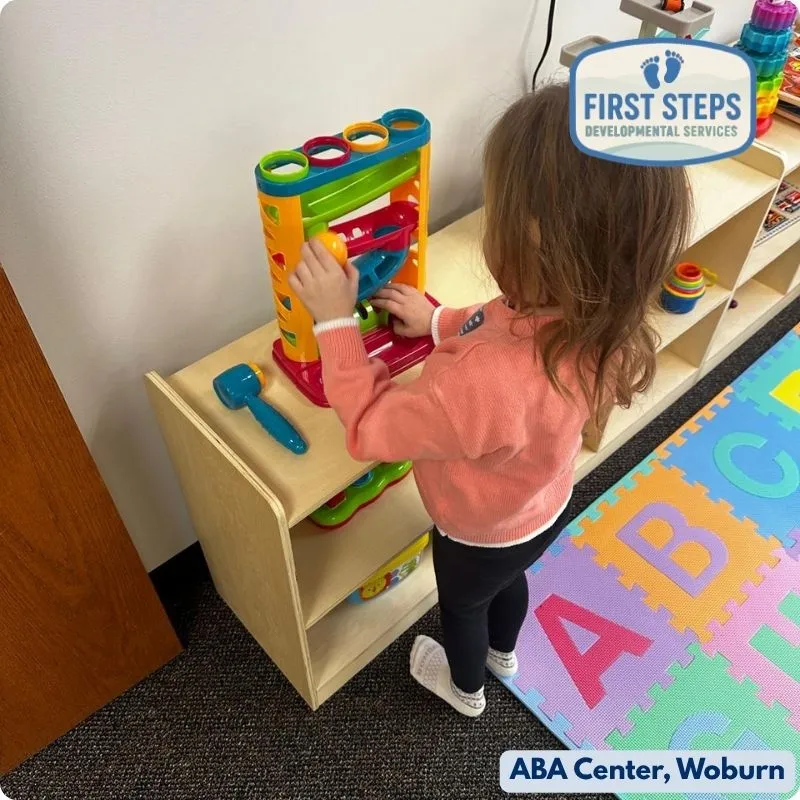
In a play-based ABA session, a therapist might use a child’s favorite toy to create opportunities for communication, turn-taking, or problem-solving — all while the child experiences it simply as play. Goals are individualized, data is tracked carefully, and the plan adjusts as the child grows. For toddlers under three, sessions are often shorter and more frequent. For children aged three to six, full- or half-day programs allow for more intensive skill-building across social, communicative, and adaptive domains.
The Centers for Disease Control and Prevention (CDC) notes that early intervention services can greatly improve the development of a child with autism spectrum disorder, which is why structured support during these years matters so much for language and social growth.
Caregiver Involvement: Why It Matters So Much
The most effective early intervention programs treat families as partners, not observers. Parents and caregivers who learn the strategies their child’s therapist uses can reinforce those skills across every environment — during mealtimes, bath time, car rides, and afternoon play. This consistency is one of the strongest predictors of how quickly and durably children generalize new skills.
Families from Stoneham and Andover who have worked with structured early intervention programs describe the coaching component as unexpectedly valuable — not just for their child, but for their own confidence as a caregiver navigating a new landscape.
How to Get Started: What the Process Actually Looks Like
The path from concern to services is more straightforward than most families expect, especially when working with a center that has experience guiding families through the process.
Step 1: Request a Developmental Evaluation
A developmental evaluation assesses your child’s current skills across communication, social interaction, play, motor development, and daily living. This evaluation becomes the foundation for an individualized treatment plan. You do not need a formal autism diagnosis before requesting an evaluation — developmental concerns alone are sufficient to start the process.
Step 2: Review Insurance and Coverage
In Massachusetts, insurance companies are required by law to cover ABA therapy for children with an autism diagnosis. Many early intervention services are also covered under standard insurance plans. Understanding what your plan covers is an important early step, and a good provider will help you navigate that process rather than leaving you to figure it out alone.
Step 3: Start Services Without Delay
The most important step is the first one. For families in Woburn and throughout Middlesex County, accessing early intervention for toddlers with autism does not have to mean months on a waitlist or months of uncertainty about what to do next. Centers that prioritize families and maintain current availability make it possible to move from evaluation to active support quickly.
Questions Families Ask Most
My child is almost five — have we really missed the window?
No. Children under six are still in a critical period for language and social development, and structured support during this time produces real, lasting gains. The concern about “missing the window” is understandable, but it’s based on an oversimplification of how brain development actually works. Starting at four or five is meaningfully different from starting at two, but it is not too late. What matters most is starting now.
How do I know if my toddler needs ABA or speech therapy?
Many children benefit from both, and the two are not mutually exclusive. ABA addresses the broader patterns of learning, communication, behavior, and social engagement that shape how a child participates in daily life. Speech therapy zooms in on the mechanics and use of language specifically. A developmental evaluation will clarify which combination of supports makes the most sense for your child’s current profile.
What if my child doesn’t have a diagnosis yet?
You do not need to wait for a formal diagnosis to seek a developmental evaluation or to ask about early intervention services. Many children begin receiving support before a diagnosis is confirmed. If you have concerns about your toddler’s development — whether around speech, social connection, behavior, or daily routines — those concerns alone are reason enough to reach out. Waiting for a diagnosis before seeking evaluation typically only delays the support your child could be receiving now.
Your Child’s First Step Starts With Yours
The question parents carry — “Is it too late?” — almost always has the same answer: no. What matters is not the exact age at which support begins, but the quality and consistency of that support once it starts. For children under six, the brain’s capacity for growth is remarkable, and early intervention is one of the most evidence-backed tools available to families navigating this path.
The families who describe the greatest sense of relief are usually the ones who stopped waiting and took a first step, even without knowing exactly where it would lead. A conversation, an evaluation, a plan. That is how it starts.
First Steps Developmental Services supports children from birth through age six in Woburn and surrounding communities throughout Middlesex County, including Winchester, Burlington, Wilmington, Lexington, Arlington, Andover, and Stoneham. To ask questions or schedule a free 30-minute parent support call, please contact the First Steps Developmental Services team.
About the Author
Jarrod Scalzo, MSEd, BCBA, LABA, is the Founder and CEO of First Steps Developmental Services, an ABA therapy center dedicated to supporting young children with autism, Down syndrome, and developmental delays, along with the families who care for them. With over 20 years of experience in special education and Applied Behavior Analysis, Jarrod earned his Master’s degree in Severe Special Needs Education from Simmons University in 2009 and became a Board Certified Behavior Analyst in 2014. He founded First Steps Developmental Services with a mission grounded in his own experience as a parent: to give every family the tools, knowledge, and compassionate support they need to help their child build a strong foundation for lifelong success. His approach centers on evidence-based care, caregiver partnership, and creating environments where children feel safe enough to grow.