Speech Delay vs. Autism: How to Tell the Difference
If your toddler isn’t talking as much as other kids their age, it’s natural to wonder what’s going on — and it’s natural to worry. Early ABA services for young children exist precisely for moments like this one, when parents need clear answers rather than another “wait and see.” Speech delay and autism can look similar from the outside, but they’re not the same thing, and knowing the difference matters enormously for getting your child the right support. This guide walks you through what to look for, what the milestones mean, and when it’s time to reach out to a professional.
Speech Delay and Autism Are Not the Same
A speech delay means a child is developing language more slowly than expected for their age. They might have fewer words than typical, or they might struggle to combine words into simple phrases. But here’s what’s important: a child with a speech delay alone is usually still reaching out, still making eye contact, still bringing you toys to show you something exciting. The communication drive is there, but the words just aren’t keeping up yet.
Autism spectrum disorder (ASD) is a neurodevelopmental condition that can include speech delays, but language is only one piece. Children with autism may also show differences in social connection, play, sensory processing, and the flexibility of their routines. A child might have a large vocabulary and still be autistic. Another child might be nonverbal and not autistic at all. That’s what makes this question so genuinely tricky to answer without a proper evaluation.
Signs That Point to Speech Delay vs. Autism
What speech delay often looks like
Children with speech delays tend to communicate in other ways even when words are limited. Watch for these patterns:
- Points to things they want or want to show you
- Responds to their name consistently
- Makes eye contact naturally during play or interaction
- Uses gestures like waving or reaching with clear intent
- Engages in back-and-forth play, even without words
- Imitates your actions and facial expressions
These children want to connect. The language is delayed, but the social instinct is intact.
What autism may look like in young children
Early signs of autism are often about the broader pattern of communication and social engagement, not just speech. Families in Woburn, Winchester, and Burlington have described moments like: a child who doesn’t turn when their name is called, or who lines up toys the same way every day and becomes very upset when the routine shifts. Other common early signs include:
- Limited or inconsistent eye contact
- Not pointing to share interest (e.g., pointing at a dog to show you)
- Rarely imitating others or playing pretend
- Repetitive movements such as hand-flapping or rocking
- Strong preference for sameness in routines or environment
- Unusual responses to sound, texture, or light
- Words that appear and then disappear (regression)
None of these signs alone means a child has autism. But a cluster of them, especially if they’re consistent across different settings and caregivers, is worth discussing with a developmental specialist.
Speech Milestones to Know for Children Under Six
Developmental milestones give families a framework, not a final verdict. Think of them as useful checkpoints, not pass-or-fail tests. Here’s what is typically expected at each stage for toddlers and preschool-aged children:
By 12 months
- Says a few words like “mama” or “dada” with meaning
- Responds to simple requests (“Wave bye-bye!”)
- Points, waves, and uses other simple gestures
- Looks toward you when you call their name
By 24 months
- Uses at least 50 words and is starting to combine two words (“more milk,” “Mama go”)
- Points to pictures in books when named
- Engages in simple pretend play
- Strangers can understand about half of what they say
By 36 months
- Speaks in short sentences of three or more words
- Vocabulary has expanded noticeably
- Can follow two-step instructions
- Engages in simple conversations
Families often reach out when their child is approaching one of these milestones and something feels off. That instinct is worth trusting. If a child is missing multiple markers at a given age, or if you are noticing regression where words or skills that were once there have started to disappear, that is a clear signal to seek an evaluation sooner rather than later.
Where Speech Delay and Autism Overlap
Here’s where it gets genuinely complicated: many children with autism have speech delays, and many children with speech delays do not have autism. There’s no single test parents can do at home to draw a clean line between the two.
What professionals look at is the full picture of how a child communicates, plays, and connects. We don’t count how many words they have. A child who has 30 words but doesn’t use them to connect with people, who doesn’t point or follow a gaze, who prefers to play alone with objects in very specific ways, may be showing a different pattern than a child who has 30 words and is constantly trying to interact but just can’t get the words out fast enough.
The Centers for Disease Control and Prevention (CDC) recommends that children be screened for autism at 18 and 24 months during regular well-child visits, in addition to general developmental screening at 9, 18, and 30 months. If a pediatrician hasn’t initiated that conversation, parents in Wilmington, Stoneham, and the surrounding Woburn area can ask for it directly.
What to Do If You’re Concerned
The most important thing is not to wait. The early years, especially birth through age six, are when the brain is building its fastest connections. Support provided during this window tends to have a much greater impact than the same support provided later. This is true whether a child has a speech delay, autism, or both.
Start with your child’s pediatrician and ask for a developmental screening or a referral to a developmental specialist. You can also reach out directly to an ABA therapy center or early intervention provider in your area without a formal referral in many cases. At First Steps Developmental Services in Woburn, families can begin with a free 30-minute parent support call to talk through what they’re seeing and figure out the right next steps.
Parents in Stoneham, Billerica, Burlington, Winchester, Lexington, and Andover have found that just having that first conversation with someone who understands what they’re describing and doesn’t rush them off the phone could make an enormous difference in how they feel about the road ahead.
How ABA Therapy Supports Communication
Applied Behavior Analysis (ABA) is one of the most well-researched approaches for supporting children under six with autism and developmental delays. At First Steps Developmental Services, ABA is delivered through a modern, compassionate lens — play-based, child-led, and grounded in what makes each individual child feel safe enough to grow.
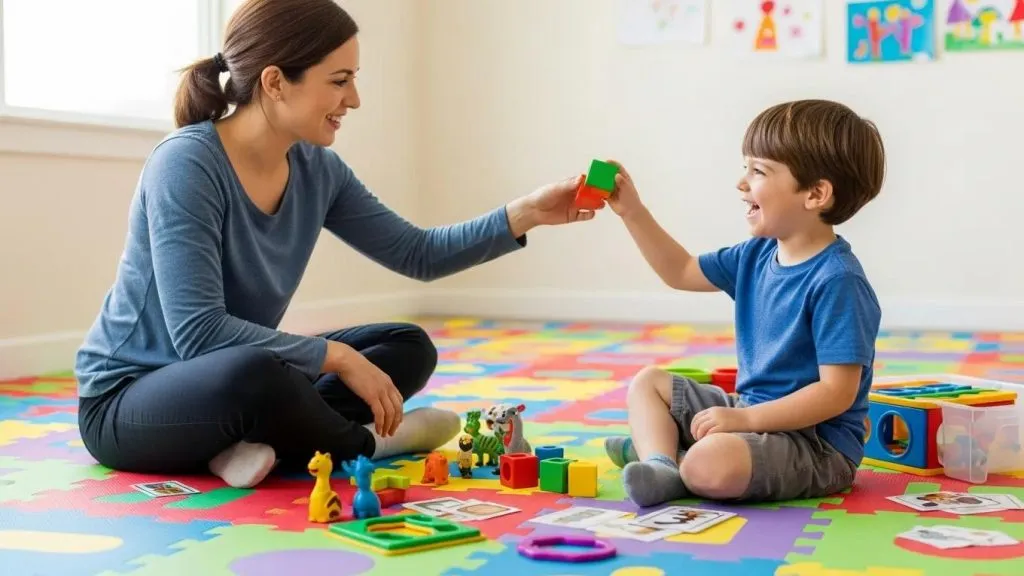
ABA therapy for communication might look like a therapist playing with a child on the floor, creating natural opportunities for the child to request things they want, to imitate sounds or words, or to respond to their name in a low-pressure, joyful context. Parents are included as partners throughout the process, which means strategies learned in the therapy room can be woven into daily life at home.
For children whose delays are primarily speech-related, ABA can complement speech-language therapy by reinforcing communication skills across all the settings where a child lives and learns at the center, at home, and eventually at school or daycare.
Questions Parents Ask Us Most
Can an Affectionate Child Still Have Autism?
Yes. The idea that autistic children don’t make eye contact or don’t want connection is a widespread misconception. Many autistic children are deeply affectionate and do make eye contact, especially with familiar people they feel comfortable with. What’s more informative is the full pattern of development, including how they play, how they respond to changes in routine, and how they communicate beyond words. A proper evaluation looks at all of these pieces together.
Is it possible to have both a speech delay and autism?
Absolutely. In fact, this is common. A child can receive an autism diagnosis and still benefit significantly from speech therapy alongside ABA support. The goal is always to understand what that specific child needs and not to fit them into one category or another. Getting an evaluation gives families a clear picture of exactly what’s going on so services can be matched to actual needs.
What If the Evaluation Finds Nothing Wrong?
Then you’ll have peace of mind, and that’s not nothing. Pediatric specialists and early intervention providers are not looking to label children. They’re looking to give families accurate information so they can make good decisions. If a child is developing typically, an evaluation confirms that. If there’s something that would benefit from support, finding it early makes an enormous difference. Either way, asking is always the right move.
Getting Answers Is the First Step
Watching your child and wondering whether something is off is one of the hardest parts of early parenthood. You’re not overreacting by asking questions, and you’re not failing your child by seeking an evaluation. You’re doing exactly what good parents do: paying attention.
The difference between speech delay and autism matters because it shapes what kind of support will help most. But in either case, the best time to act is now while the brain is at its most responsive and the window for early intervention is wide open. Families in Woburn, Arlington, Wilmington, Burlington, and Winchester don’t have to figure this out alone.
First Steps Developmental Services in Woburn offers a free parent support call to help families understand what they’re seeing and identify the right next steps. There is no waitlist and no pressure to commit to services. To get in touch, contact us.
Meet the Expert Leading First Steps Developmental Services
Jarrod Scalzo, MSEd, BCBA, LABA, is the Founder and CEO of First Steps Developmental Services, an ABA therapy center dedicated to supporting young children with autism, Down syndrome, and developmental delays, along with the families who care for them. With over 20 years of experience in special education and Applied Behavior Analysis, Jarrod earned his Master’s degree in Severe Special Needs Education from Simmons University in 2009 and became a Board Certified Behavior Analyst in 2014. He founded First Steps Developmental Services with a mission grounded in his own experience as a parent: to give every family the tools, knowledge, and compassionate support they need to help their child build a strong foundation for lifelong success. His approach centers on evidence-based care, caregiver partnership, and creating environments where children feel safe enough to grow.