
Sensory Play Activities for Toddlers With Autism
If your toddler with autism avoids certain textures, reacts strongly to sounds, or seems overwhelmed by everyday experiences, sensory play can be one of the most powerful tools in your parenting toolkit. Supporting play-based learning at home does not require fancy equipment or a therapy degree. It starts with simple, intentional activities that meet your child exactly where they are. The right sensory games for toddlers with autism build comfort, expand tolerance, and open the door to communication and connection, all through the kind of exploration young children do naturally.
Why Sensory Play Matters for Autistic Toddlers
Children with autism often experience the world differently through their senses. A tag on a shirt, the hum of the refrigerator, or the feel of grass underfoot can be genuinely overwhelming. Sensory play for autism works by gently exposing children to different textures, sounds, and materials in a low-pressure, child-led way, helping their nervous systems learn to process input more comfortably over time.
When sensory activities are woven into daily routines, children ages 2 to 6 often show improvements in attention, emotional regulation, and willingness to try new things. Parents in Woburn, Winchester, Burlington, and across the greater Middlesex County area have seen firsthand how a simple bin of kinetic sand or a water table can shift the tone of an entire morning.
Getting Started: A Few Things to Know First
Before diving into specific activities, it helps to understand your child’s sensory profile. Some children with autism are sensory-seeking, meaning they actively look for more input. Others are sensory-avoiding, and certain textures or sounds genuinely distress them. Many toddlers are a mix of both depending on the context.
The activities below are organized to address both profiles. Always follow your child’s lead. If they push something away, respect that signal and try again another day. Small, repeated exposures build tolerance far more effectively than pushing through discomfort.
Sensory Activities for Autism at Home
Tactile Bins for Toddlers Ages 2 to 4
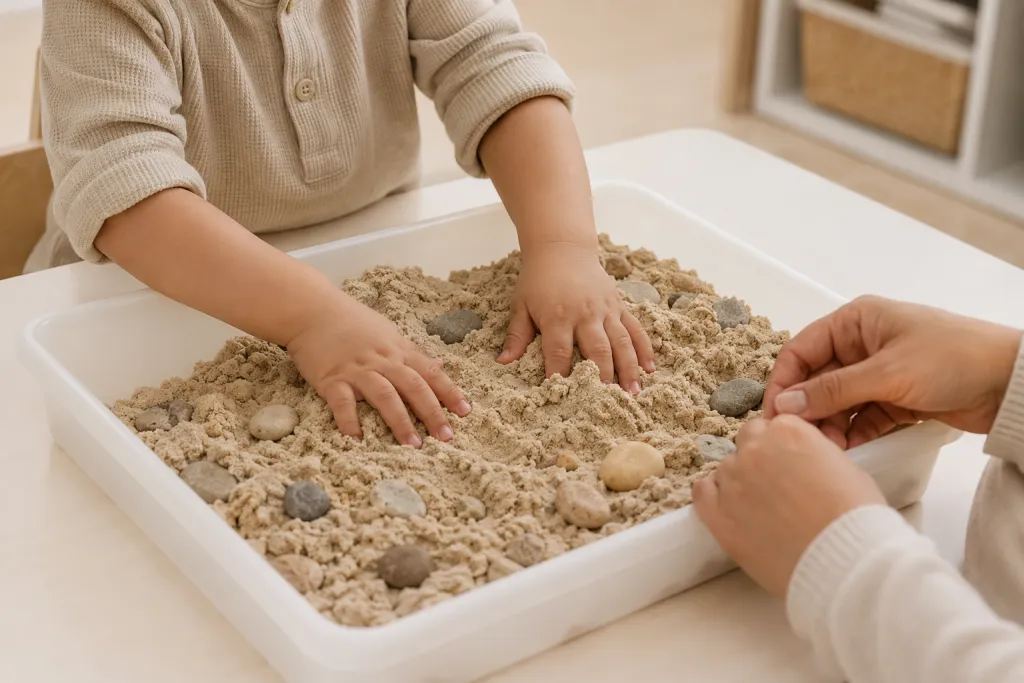
Tactile bins are one of the most accessible sensory activities for autistic toddlers. Fill a shallow plastic container with one material at a time, such as dried rice, kinetic sand, dried pasta, or shredded paper. Let your child explore at their own pace without instruction or pressure.
For children who are tactile-avoiding, start with materials that feel more neutral like dried beans or smooth pebbles. Over several sessions, you can gradually introduce items with more texture. For sensory-seeking children, wet sand, slime, or water beads offer rich input that can help them feel regulated and focused.
Water Play for Sensory and Language Growth
A simple basin of water with a few cups, funnels, and small toys gives toddlers with autism a rich sensory experience and natural opportunities for language. Pouring, splashing, and scooping all build fine motor control. Narrating what your child is doing as they play, “you’re pouring the water in,” reinforces vocabulary without pressure.
Water temperature can also be part of the experience. Slightly warm water tends to be calming, while cool water can be alerting. Families in Wilmington, Lexington, and Arlington have found water play especially useful during transitions or before activities that tend to trigger dysregulation.
Sensory Play With Playdough and Clay
Homemade playdough with scents added (lavender, vanilla) combines tactile and olfactory input, two sensory channels at once. Rolling, pressing, and squeezing builds hand strength while giving toddlers meaningful sensory input. For children who resist touching it at first, try placing the dough in a zip-lock bag so they can squeeze it without direct contact and work up from there.
Movement-Based Sensory Games for Toddlers
Proprioceptive input, the sensation of muscles and joints being engaged, is deeply regulating for many autistic children. Simple activities like rolling a therapy ball over a child’s back, jumping on a mini trampoline, or crawling through a tunnel provide this input in a playful, non-threatening way.
Vestibular activities such as swinging, spinning slowly in a desk chair, or rocking on a rocking horse also help the brain process movement input. If your toddler seeks spinning or rocking behaviors throughout the day, structured movement activities can actually help reduce that need by satisfying it intentionally.
Visual and Light-Based Sensory Exploration
Some autistic toddlers are highly drawn to visual input. A simple light-up toy, a lava lamp, or a sensory bottle (a clear bottle filled with water, glitter glue, and small objects that float when shaken) can hold attention and provide a calming focal point. These activities work well as a transition tool before a demanding task or at the start of a quiet period.
How to Build Sensory Play Into Daily Routines
The most effective sensory activities for autism are not isolated sessions. They are habits woven into everyday life. A few practical ways to do this:
- Add a tactile bin to your child’s play corner and rotate materials every few days to maintain interest.
- Use water play as part of bath time rather than a separate activity, extending it a few extra minutes for sensory exploration.
- Incorporate movement breaks between activities, two minutes of jumping or rolling before sitting for a meal or quiet task.
- Pair sensory play with simple language by narrating what you see and what your child is doing, without expecting a verbal response every time.
The Centers for Disease Control and Prevention (CDC) notes that early developmental support during the first years of life, when the brain is most adaptable, can have significant long-term effects on learning and behavior outcomes for children with autism.
When Sensory Play Connects to ABA Therapy
Many of the principles behind effective sensory play are the same ones that guide play-based Applied Behavior Analysis therapy. Child-led exploration, graduated exposure, positive reinforcement, and following the child’s cues are central to both.
At First Steps Developmental Services in Woburn, MA these sensory approaches are integrated into individualized ABA programs for children ages 2 to 6 with autism, Down syndrome, and developmental delays. Therapists track each child’s responses, identify patterns, and adjust activities to match where the child is developmentally, not where a chart says they should be. Families across Stoneham, Andover, and Billerica have come to First Steps Developmental Services because the approach feels human and grounded rather than clinical and rigid.
What makes this integration meaningful is caregiver involvement. When parents understand why a particular activity is being used and how to extend it at home, the child gets exponentially more practice. That practice is what drives real progress.
Questions Families Often Ask About Sensory Play
What if my toddler refuses every sensory activity I try?
This is more common than most parents realize. Refusal is information, not failure. It tells you that your child’s nervous system is currently overwhelmed by that input. Start with visual observation only: let your child watch you play with the material without any expectation that they will touch it. Some children take weeks before they are ready to engage, and that timeline is completely valid.
Can sensory play replace professional therapy for autism?
Sensory play at home is a valuable complement to professional support, not a substitute. Play-based ABA therapy provides structured, data-driven programming that tracks progress and adapts to each child’s needs in ways that home activities alone cannot replicate. Think of home sensory play as reinforcing and extending what a skilled therapist builds with your child.
At what age should we start sensory activities for autism?
The earlier, the better. Children as young as 12 to 18 months can benefit from simple sensory exploration, and starting early takes advantage of the brain’s greatest period of plasticity. If you have noticed differences in how your toddler responds to sensory input, it is never too early to reach out to a specialist and get a clearer picture of what your child needs.
The Path Forward Starts With Play
Sensory activities for autism are not about fixing your child. They are about helping your child feel safe enough to explore, connect, and grow. When a toddler who once refused all wet textures finally digs both hands into a sandbox, that is not a small thing. That is their nervous system learning that the world can be manageable, and even joyful.
The families who see the most meaningful progress are the ones who approach this with patience, consistency, and the right professional partners alongside them. Every child’s sensory profile is different, and every plan should be built around that specific child rather than a generic script.
If you are ready to explore what structured, compassionate, play-based support could look like for your toddler, First Steps Developmental Services is here. Reach out to learn more or schedule a free 30-minute parent support call.
Meet Our Founder: Expert ABA Leadership and Care
Jarrod Scalzo, MSEd, BCBA, LABA, is the Founder and CEO of First Steps Developmental Services, an ABA therapy center dedicated to supporting young children with autism, Down syndrome, and developmental delays, along with the families who care for them. With over 20 years of experience in special education and Applied Behavior Analysis, Jarrod earned his Master’s degree in Severe Special Needs Education from Simmons University in 2009 and became a Board Certified Behavior Analyst in 2014. He founded First Steps Developmental Services with a mission grounded in his own experience as a parent: to give every family the tools, knowledge, and compassionate support they need to help their child build a strong foundation for lifelong success. His approach centers on evidence-based care, caregiver partnership, and creating environments where children feel safe enough to grow.